
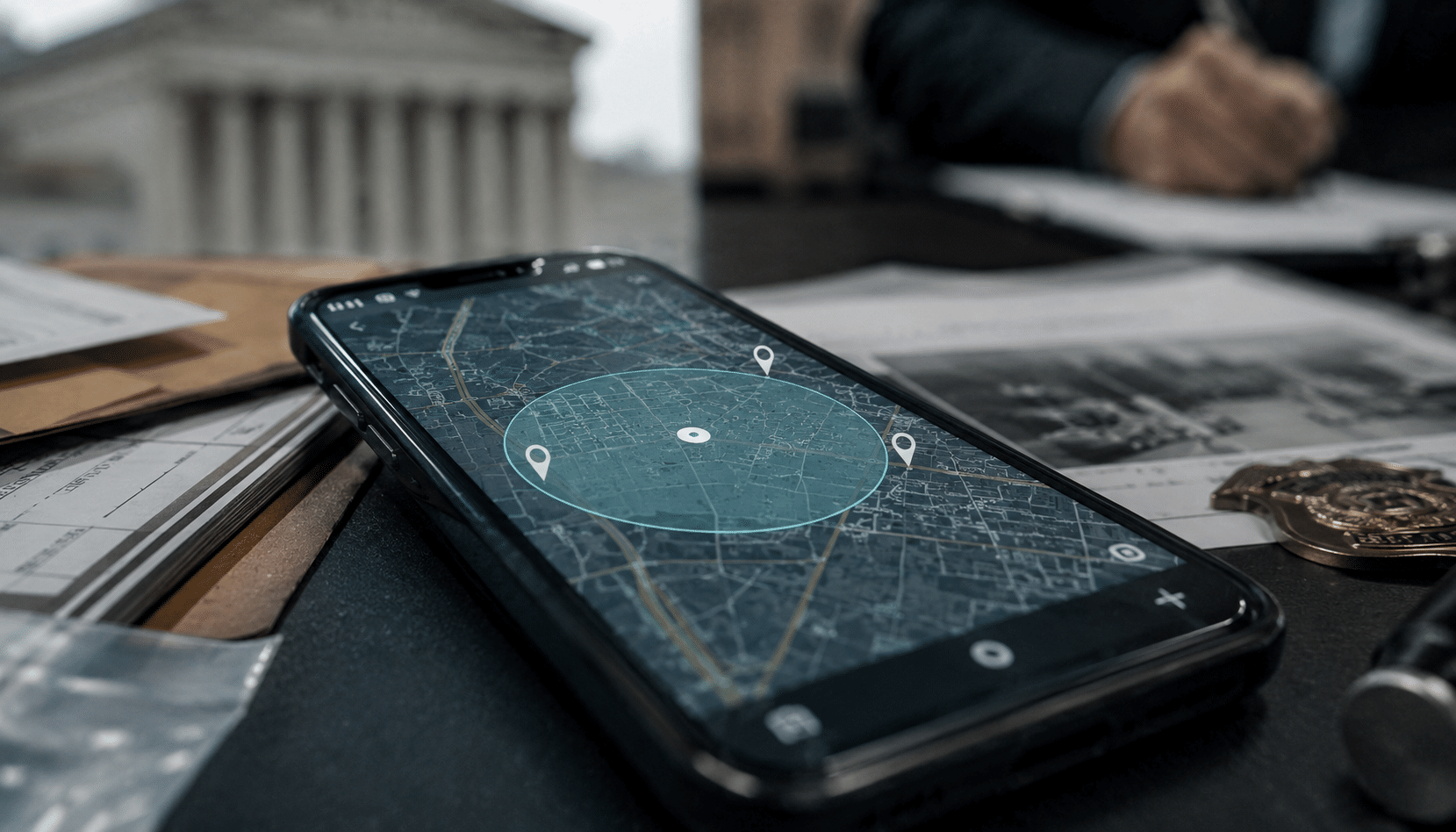
This summer the United States Supreme Court issued its opinion Chatrie v. United States—and radically shifted how the Fourth Amendment and smartphones interact. Chatrie dealt with law enforcement’s use of geofence warrants to investigate crimes—an issue that has become much more prevalent the last few years. Geofence warrants consist of law enforcement identifying an area around the physical location where a crime occurred—usually a circle centered on the location—and ask Google or another company for an anonymous list of all cellphones within that circle for a given period of time. Law enforcement examines that list before narrowing it down further and then going back to the company to identify the people flagged on the narrowed list.
The question in Chatrie was whether this constituted a search within the meaning of the Fourth Amendment—meaning was a warrant required. Generally speaking, a search warrant is only required when the law enforcement seeks to search an area or thing that a person has a reasonable expectation of privacy in. A classic example of this concept is a house—a person has a reasonable expectation that they what happens in their home is private. The same concept applies to cellphones; a warrant is required to search a person’s cellphone for evidence of a crime.
But, when a person makes otherwise private information available to the public or a third-party, they generally give up that expectation of privacy. Legally this is known as the third-party doctrine. This doctrine originally arose from cases holding that a person lacks a reasonable expectation of privacy in canceled checks and deposit slips that had been given to a bank and in call records for a landline because the person provided a number to the telephone company when the call was placed.
In United States v. Carpenter, however, the Supreme Court upended the third-party doctrine when it came to cell-site location data from a cellphone. Cell-site location data is a record of what cellphone towers a particular cellphone connects to at a given time. This information can be used to trace a cellphone—and presumably the cellphone’s owner—as the cellphone connects to different towers. In Carpenter, the Supreme Court held that, even though the cellphone company has access to cell-site location data, the third-party doctrine did not apply because of the privacy implications involved. As the Supreme Court noted, cellphones have become ubiquitous and indispensable in modern life. And because cellphones only work because they connect to cellphone towers, there is no voluntary sharing of the cell-site location data. Critically, Carpenter emphasized the reasonable expectation of privacy a person has in their daily movements—which is what triggers the need for a search warrant.
After Carpenter, lower courts around the country largely treated the decision as a very limited one-off exception to the third-party doctrine. The rationale in Carpenter was not applied to cellphone apps that involved location data or other types of information that are automatically shared when using apps. In United States v. Trader, the Eleventh Circuit Court of Appeals held that Carpenter did not apply to IP addresses or email addresses that provided to KIK by voluntarily downloading and using the app.
The location history data at issue in Chatrie was far more invasive than the cell-site location data at issue in Carpenter. Cell-site location data shows that a cellphone connected to Tower A and could be anywhere in range of Tower A. The location history data in Chatrie worked by GPS and by pinging off sources of Wi-Fi, Bluetooth, IP addresses, and cell towers. This greatly narrows down a cellphone’s location to a very precise spot.
Chatrie upends the limited view of Carpenter by making clear that information that is shared as “the automatic price of price of conventional cellphone usage” does not fall under the third-party doctrine. The Supreme Court based this on the fact that “the point of carrying smartphones is to use what is on them—as Carpenter said, to use the apps and serves they provide.” Moreover, the Supreme Court rejected the government’s position that determining whether the third-party doctrine applied should depend on the specific app at issue.
Chatrie also ended the question of whether a limited search requires a search warrant. The government argued that the Fourth Amendment did not apply because geofences operate for a specific and limited window of time rather than an extended look at a cellphone’s location. The Supreme Court rejected that argument and explained that the Fourth Amendment does not suddenly apply because law enforcement’s search crossed some threshold. A search is a search whether it is a quick peak or an in-depth examination.
While Chatrie held that geofences are a search within the meaning of the Fourth Amendment, the Supreme Court did not address the details of what an affidavit requesting a geofence warrant must establish—beyond making it clear that the probable cause and particularity are required at every step of the geofence process. Instead, the Court remanded the case back to the Fourth Circuit to determine whether the warrant in Chatrie passed constitutional muster.
Beyond geofences, Chatrie has broad implications for all searches involving cellphones and other types of digital information. In Trader, the Eleventh Circuit specifically held that IP addresses were not covered by Carpenter, but Chatrie included IP addresses in its analysis of the geofence warrants. Similarly, tower dumps—requesting information for all cellphones connected to a tower at a given point in time—are almost certainly affected by Chatrie because they are functionally very similar to geofences.
Maybe the biggest question that is going to have to answered after Chatrie is how far does it extend. Does this same rationale apply to laptop computers? After all cellphones are increasingly miniature laptop computers. After all, the same considerations involved with cellphone locations also apply to laptops: they are portable and rely on IP addresses, Wi-Fi connections, and Bluetooth connections.
Time will tell how lower courts apply Chatrie. The Supreme Court remanded a number of cases involving geofence warrants to lower courts to reconsider based on the reasoning in Chatrie.
