
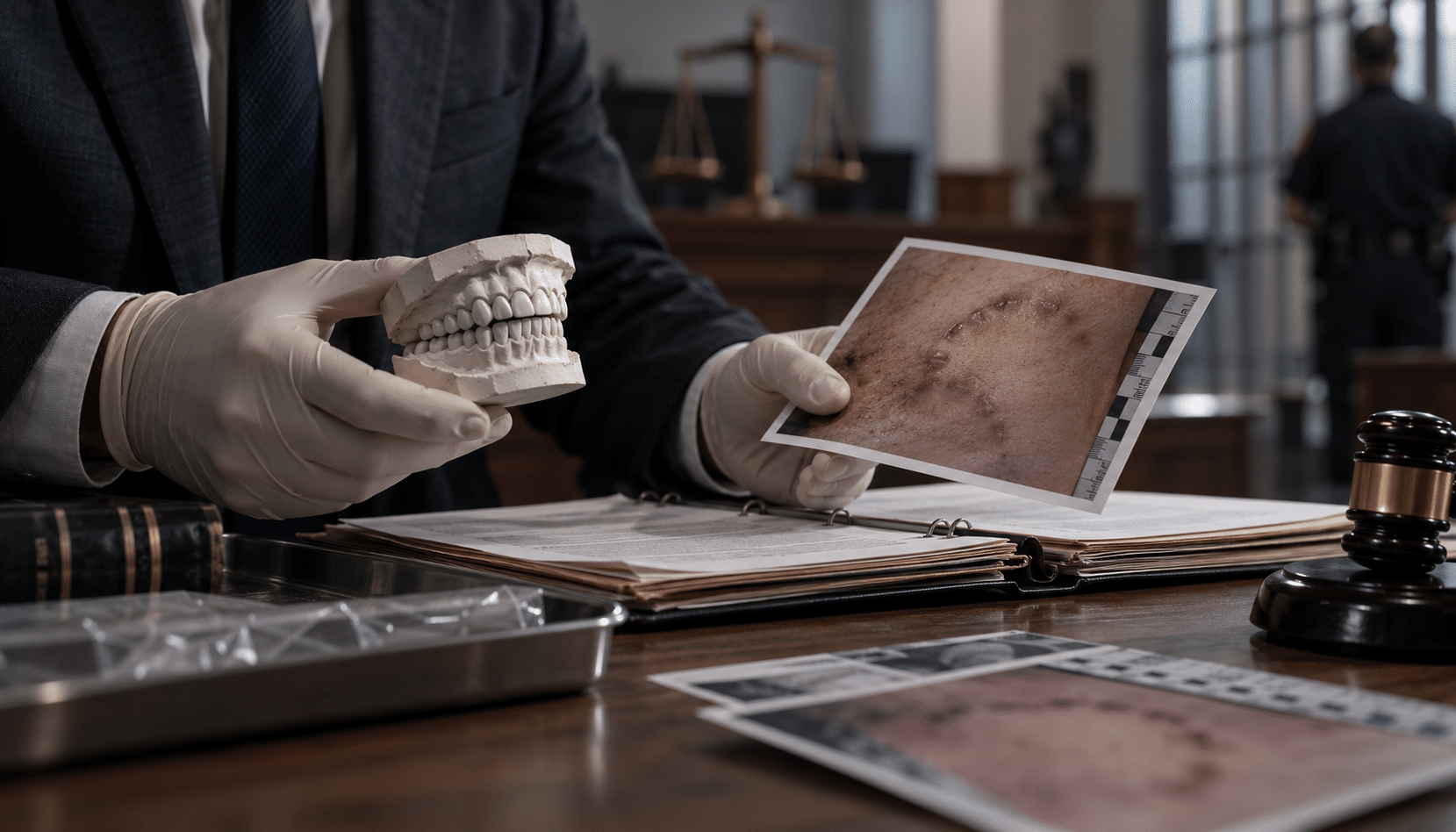
On September 21, 2026, United States District Court judge Huffaker in the Middle District of Alabama granted habeas relief to Charles McCrory due to the centrality of bite mark comparison testimony by Dr. Souviron to his conviction for the 1975 murder of his wife Julie Bonds McCrory. As the order noted, “The science behind that evidence is no longer considered reliable and the State’s own expert witness at McCrory’s murder trial has since recanted his expert opinion.” Bite mark comparison involves comparing a person’s teeth to marks on a victim to “determine” whether the person’s teeth matched the victim’s marks.
McCrory was initially convicted in 1986; but, in 2002, he began arguing that he was entitled to a new trial due in part to newly discovered evidence undermining bite mark comparisons as scientifically valid. By that point, the forensic odontologist—who normally help identify remains through dental records—who did the bitemark comparison in McCrory’s case and testified at trial that the bitemarks found on the body matched McCrory’s teeth had published an article discrediting bite mark comparisons. McCrory also referenced a study showing the false-positive rate for bite mark comparison to be 63.5%. The Rule 32 petition McCrory filed in 2002 was ultimately dismissed.
In 2020, McCrory filed a second Rule 32 petition. In this petition, he attacked the use of bite mark evidence as a violation of Due Process and that newly discovered evidence, including an affidavit from Dr. Souviron, entitled him to a new trial. Dr. Souviron’s affidavit stated that he no longer believed there was a scientific basis for the bite mark comparison testing he testified about at trial—Souviron went so far as to acknowledge that there was no evidence that the marks on Bonds McCrory were teeth marks. As he noted, the scientific consensus was that bite mark evidence was unreliable and scientifically unsupported. McCrory also provided testimony from two other forensic odontologists about the problems with bite mark comparisons. Despite this, the trial court denied the second Rule 32 petition and the Court of Criminal Appeals affirmed that decision.
At that point, McCrory moved to federal court to challenge his convictions through 28 U.S.C. § 2254, which allows federal courts to grant habeas relief for constitutional violations in state court convictions. Before a person can obtain relief under § 2254, they have to show that the state court’s denial of relief was “contrary to or involved an unreasonable application of clearly established federal law or based on an unreasonable determination of the facts in light of the evidence presented to the state court. The district court found that McCrory satisfied that heavy burden.
Much of the order deals with procedural aspects of § 2254 and the requirements of the Anti-Terrorism and Effective Death Penalty Act that sharply limits when a state defendant is entitled to federal habeas relief. A critical dispute that the district court decided in McCrory’s favor was whether the newly discovered evidence claim was brought in a timely manner. The district court held that the critical evidence that was newly discovered was Dr. Souviron’s affidavit in 2019—meaning that filing deadlines are based on the date the affidavit was obtained.
When the Court reached the merits of the case, the district court wasted no time in finding that the state courts’ decisions on the newly discovered evidence claim constituted an unreasonable application of clearly established federal law. For this, the district court looked to Supreme Court decisions establishing that when a trial court’s evidentiary mistakes are extreme enough it can violate Due Process. Notably the State never disputed the inadmissibility of Dr. Souviron’s testimony to establish that a legal error clearly occurred.
Similarly, the district court quickly found that the state courts made unreasonable determinations of fact based on the evidence. Specifically, this error arose from the determination that even without Dr. Souviron’s testimony the jury’s could look at the bitemark evidence and find that it belonged to McCrory. As the district court pointed out, this idea was nonsense in light of the modern consensus that bitemark evidence is completely unreliable and largely inaccurate. Comparisons like what Dr. Souviron performed in the 1980s cannot really say whether a “bite mark” is in fact a bite mark. As a result, there was simply no basis for the state court to determine that the jury could have made the comparison themselves.
The end result of the district court’s analysis is that McCrory is entitled to habeas relief due to clear constitutional violations that occurred in the original trial and ordered his release. As part of its ruling, the district court stayed the enforcement of its order for 180 days from the date of the order to allow the State time to conduct a second trial. If a new trial does not happen within that time period, McCrory is to be released.
What will almost certainly happen now is that the State will appeal this decision to the Eleventh Circuit Court of Appeals. There the State will almost certainly argue that the procedural aspects of the district court’s order were incorrect and that the state court’s decision was not unreasonable legally or factually.
